





Eye For Film >> Movies >> Ürei (2020) Film Review


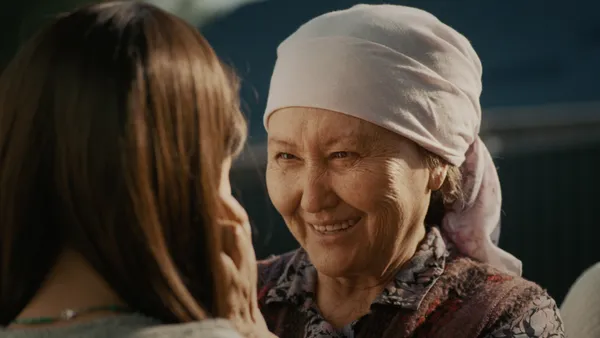

Adapted by Yerkezhan Baizhan from her 2024 short of the same name, and screened at Fantastic Fest 2026, this film extends the idea of a babysitting session gone dreadfully wrong to tell the story of a troubled teenager sent away to stay with her gradually declining grandmother in a remote Kazakh village. It’s a story about the love which ought to keep families together but which, when it goes wrong, can destroy everything they are. At times its events seem wildly unlikely, and yet anyone who has cared for somebody in the late stages of dementia knows how far it can carry people from reality; and we might any of us reflect on the distortion that our own feelings can undergo in moments of distress.
It begins with 13-year-old Kalima (Akerke Kozaiyr) being driven out into the countryside, sullen in the back seat. Her mother, Aliya (Gulbahram Baybosynova) snipes at her, and at her father (Asset Eszhan), throughout the journey. She’s not allowed to have her phone, she’s told. She can’t be trusted. It’s a miserable journey. When they finally arrive, she is grateful for the kindly embrace that her grandmother (Tynyshgul Sultanberdieva) has to offer. Once her parents have been fed and shooed out of the door, there are fried potatoes, and finally she can enjoy some peace.
Kalima has been lonely for a long time. Her father is working long hours, trying to provide for the family, and has taken it for granted that her mother will look after her. Pressure has slowly built up to the point where her mother is desperate for a life of her own, which has led to the two of them rowing and treating her as a burden, so of course she has misbehaved, seeking comfort elsewhere. What she doesn’t know is that her grandmother is also dealing with trauma, buried just below the surface. On that first day the old woman is in a lucid state, warm and kind, but two days later Kalima will find her outside after dark, without her shoes. Her mind is going, and as it does, the past that she has tried to forget comes back to haunt her, distorting the present, and placing the girl in serious danger.
There are moments in the film when Baizhan flirts with the supernatural. One night the grandmother wanders into the living room where Kalima is sleeping, repeating the words “He’s coming” in a flat, ominous tone. This presages the arrival of a figure from her past within her mind, an experience which is abruptly overwhelming. It isn’t hard for viewers to figure out what’s going on, but it is hard to see a way out for the frightened girl. Her lack of life experience and lack of confidence weigh against her. She’s on unfamiliar territory, dealing with a phenomenon she doesn’t really understand, and she barely knows anyone for hundreds of miles, with only local boy Azamat (Miyatuly Zangar), who sometimes delivers groceries, alert to the fact that something might be wrong.
Holding all of this together is the tremendous atmosphere that Baizhan generates out of shadows, cramped locations and unsettling sounds. This is not about jump scares (though there are a few), but about a kind of pressure that grinds one down over time. The intermingling of dream scenes with reality gives us some sense of what it might be like to be inside the grandmother’s mind, but Kalima, too, gradually begins to lose track of what’s real. Some of the scenes of abuse are hard to watch, and viewers should be aware of what they’re getting into, but there is very good work here, with both leads giving themselves over fully to their roles. The lingering horror comes from the awareness that there is something of this potential inside every one of us. You might be reminded of the saying that life is short so we should hold our loved ones close whilst we can; but, perhaps, we should also let them go again, whist we still can.
Reviewed on: 19 Sep 2026


